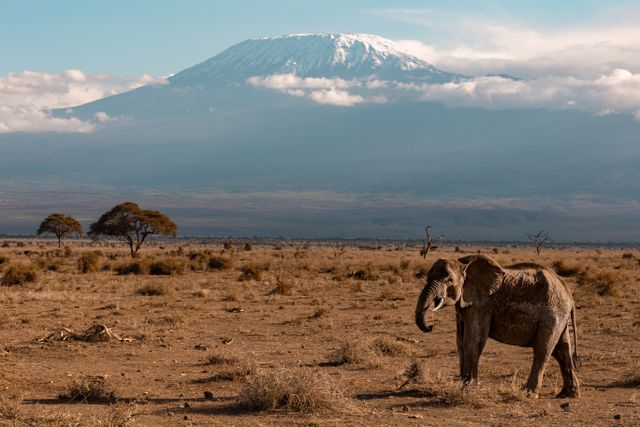
There is a photograph that exists on a remarkable number of Kenyan phones, shared from a colleague’s trip, a cousin’s holiday, a travel page you follow on Instagram: a herd of elephants crossing a pale, dusty plain with Mount Kilimanjaro filling the entire sky behind them. You have probably seen some version of it hundreds of times. What fewer Kenyans have done is stand on the soil that photograph was taken on — which sits about 230 km from Nairobi. A four-to-five hour drive from the city.
Amboseli is one of those places where proximity breeds overlooking. It is close enough to feel like ‘later.’ You have seen the photos enough that the park feels familiar even though you have never been. And there is a quiet assumption, reinforced by international travel content, that a park this famous must be expensive and complicated.
None of that is true for Kenyan residents. You pay KES 2,025 per adult per day — the premium tier under the KWS fees that took effect October 2025. An international visitor pays USD 90 (approximately KES 11,700) for the same day. The park is yours at a fraction of the international rate. This guide gives you everything to plan the visit properly: current fees, the honest Kilimanjaro photography picture, lodge options at three budget levels, the self-drive question settled, and the day trip versus overnight verdict based on how the park actually operates.
What Makes Amboseli Different
Amboseli National Park covers 392 km² of semi-arid savanna, swamp, and dry lakebed at the foot of Kilimanjaro. The mountain is technically in Tanzania, about 80 km from the park’s southern boundary — but it dominates the sky so completely that the park feels like it sits at its base.
The park’s defining ecological feature is its permanent underground water system — Kilimanjaro’s snowmelt percolates through volcanic rock for decades and resurfaces as springs, feeding the Enkongo Narok and Longinye swamp systems inside the basin. Even in the driest months, these swamps sustain wildlife at high density. This is why Amboseli works year-round in a way that purely rain-dependent ecosystems do not.
The result is an elephant experience that is simply unmatched anywhere in Kenya. The wider ecosystem supports more than 1,500 elephants, many individually known and monitored by the Amboseli Trust for Elephants — one of Africa’s longest-running wildlife research programmes. The elephants here are large, relaxed, and often extraordinarily close. You will see calves. You may see old bulls with near-floor-length ivory. No other park in Kenya delivers elephants like Amboseli.
Getting There: Routes and Road Conditions
Two main routes connect Nairobi to Amboseli. Both involve unpaved sections near the park — there is no fully tarmacked access to any Amboseli gate. A 4WD vehicle is the practical minimum.
Route 1: Via Namanga (the more popular choice)
Take the A104 highway south through Isinya and Kajiado to Namanga on the Kenya-Tanzania border. From Namanga, it is approximately 45 km of murram road to the Meshanani (Namanga) Gate — the most commonly used entry point. Total distance from Nairobi: approximately 230 km. Driving time: 4–5 hours including the unpaved approach.
Road condition note: The Nairobi–Namanga tarmac section (via Athi River) is in reasonable condition. The Namanga–Meshanani stretch is corrugated murram, dusty in dry season and slippery in wet. The route also passes through Namanga border town — no formalities required for domestic travel, but it is a busy border crossing and can be congested.
Route 2: Via Emali (the Mombasa Road option)
Take the A109/A104 Nairobi–Mombasa highway to Emali (approximately 160 km), then turn south-west through Loitokitok. The Emali–Kimana tarmac section has improved significantly in recent years and multiple travellers report smooth tarmac all the way to Kimana town, followed by the gate approach. Total distance: approximately 245–260 km. Driving time: 4–5 hours plus the Mombasa Road exit from Nairobi, which adds significant time on Friday afternoons.
Note: KWS issued an advisory in 2025 recommending the Namanga route when Mombasa Road experienced gridlock from an accident near Emali. Both routes are viable; the Namanga route avoids the Mombasa highway traffic risk.
| Route | Distance | Main Gate | Road Surface | Drive Time |
|---|---|---|---|---|
| Via Namanga (A104) | ~230 km | Meshanani Gate | Tarmac to Namanga, 45 km murram to gate | 4–5 hours |
| Via Emali (A109) | ~250 km | Kimana Gate | Tarmac to Kimana, short murram to gate | 4–5 hours |
⛽ No Fuel Inside the Park
There are no fuel stations anywhere inside Amboseli National Park.
Via Namanga: fill up in Namanga town before the murram section.
Via Emali: fill up at Emali or Kimana town before entering.
Do not enter the park below half a tank — getting stuck without fuel inside is a genuine problem.
Park Entry Fees for Kenyans: October 2026
Amboseli is classified as a premium park under the Wildlife Conservation and Management (Access, Entry and Conservation) (Fees) Regulations 2025, which took effect October 1, 2025 — the first comprehensive revision in 18 years. Premium status means it shares the highest KWS fee tier with Lake Nakuru National Park.
| Visitor Category | Adult (per 24 hrs) | Child (per 24 hrs) | Notes |
|---|---|---|---|
| Kenyan Citizen / EA Resident | KES 2,025 | KES 1,050 | Valid national ID or EA passport required |
| EAC Citizen (Uganda, Tanzania etc) | KES 1,500 | KES 750 | EAC national ID required at gate |
| Non-Resident (International) | USD 90 (~KES 11,700) | USD 45 (~KES 5,850) | Flat rate, year-round |
| Vehicle entry (car < 6 seats) | KES 800 | — | Charged per vehicle per 24-hr period |
Package Deals Worth Knowing
| Package | EAC Resident (KES) | Non-Resident (USD) | Good For |
|---|---|---|---|
| Tsavo West + Amboseli | KES 2,900 | USD 150 | Combining parks on a southern circuit trip |
| Tsavo East + Tsavo West + Amboseli | KES 4,000 | USD 215 | 4–7 day southern Kenya safari loop |
Pay via KWS eCitizen (wildlife.ecitizen.go.ke) before you arrive. Carry your payment confirmation and original national ID — the gate will not accept copies or phone screenshots as primary ID for the resident rate.
What a 2-night trip costs in park fees alone (family of 2 adults + 2 children, self-drive):
(2 adults × KES 2,025 × 2 days) + (2 children × KES 1,050 × 2 days) + (vehicle × KES 800 × 2 days) = KES 16,000. Budget for this separately from accommodation.
Best Time to Visit Amboseli
| Season | Months | Conditions | Kilimanjaro Views | Wildlife | Verdict |
|---|---|---|---|---|---|
| Short Dry Season | Jan–Feb | Warm, dry, clear. Calving season begins. | ⭐⭐⭐ Excellent | Very good — calves abundant, predator activity high | ✅ Best value. Quieter & cheaper. |
| Long Rains | Mar–May | Heavy rain, flooded tracks, poor visibility | ⭐ Often hidden | Animals dispersed. Roads very difficult. | ⚠️ Not recommended |
| Long Dry Season | Jun–Oct | Dry, dusty, cool mornings. Peak season. | ⭐⭐⭐ Best (Aug–Sep peak) | Excellent — highest animal concentration at swamps | ✅ Best wildlife. Book early. |
| Short Rains | Nov | Afternoon showers, green landscape | ⭐⭐ Variable | Good — lush, migratory birds arrive | 🟡 Decent. Cheaper than peak. |
| Festive / Mixed | Dec | Some rain, festive visitor peak, Xmas surcharge | ⭐⭐ Fair | Good | 🟡 Budget for festive premiums |
The practical choice for most Kenyan visitors: January–February. Fees are the same year-round at Amboseli (unlike Masai Mara which has seasonal pricing), but accommodation runs cheaper in green season and the park is significantly less crowded. Wildlife is excellent — calving season means large numbers of wildebeest young and the predators that follow. And January–February offers some of the best odds of a clear Kilimanjaro morning.
If seeing the Great Migration is your priority, that happens in the Masai Mara — not Amboseli. Amboseli’s seasonal highlight is its calving season and the sheer elephant volume that increases around the swamps as the dry season progresses.
Photographing Kilimanjaro: The Window, the Spots, the Honest Truth
The Amboseli-Kilimanjaro photograph is one of the most reproduced wildlife images on earth. Getting it requires three things: early rising, luck, and patience. Here is what actually happens at the mountain:
The Clear Window: 06:00–08:30
Kilimanjaro is most reliably clear in the early morning before cumulus cloud builds over the upper slopes. The window is typically 06:00 to 08:30. By 09:00–10:00, the summit is usually capped. There is sometimes a secondary clearing in the late afternoon around 16:00–17:30, but it is less reliable. At midday the mountain is almost always hidden.
What this means: you need to be in your vehicle at first light. Guests staying inside the park (Ol Tukai, Serena) can depart at 06:00 without leaving the property. Day trippers arriving from Nairobi will reach the park at 10:00–11:00 at the earliest — after the morning window has almost always closed.
The Best Spots
- Enkongo Narok and Longinye Swamp edges — Classic location. The swamp margins at dawn with elephants moving through the water, Kilimanjaro behind. Your guide or driver will know the positions by light condition.
- Observation Hill (Noomotio) — The one designated spot where you can leave your vehicle on foot. A short walk gives you 360-degree panoramic views. Best for landscape photography. Bring a wide lens. Also the standard picnic lunch stop.
- The dry lakebed — The pale, reflective lakebed creates extraordinary foregrounds. Elephant herds crossing the open white ground on a clear morning produce the most dramatic images.
- Southern park circuit — The southern section is physically closer to the mountain. On a clear morning, the views are measurably stronger from the south than from the main gate area.
Managing Expectations Honestly
Kilimanjaro is visible with a clear summit on fewer than half of all days even in prime season. Experienced Amboseli photographers have documented arriving in August — the best month — to find the mountain entirely hidden throughout their stay. The cloud builds over the summit within hours of sunrise on most days regardless of season.
Amboseli is extraordinary with or without the mountain. A morning drive through a thousand elephants, lilac-breasted rollers on every acacia, a cheetah moving across the open plains, hippos in the swamp at first light — this is the full experience. The mountain is the bonus. Do not choose your dates based only on hoping for clear mountain views; every morning in a good season is worth being there.
The Big Five at Amboseli: The Honest Reality Check
Some operators market Amboseli as a Big Five destination. This needs clarification before you arrive with expectations that do not match the park.
| Animal | Amboseli Status | Sighting Probability | Notes |
|---|---|---|---|
| Elephant 🐘 | Exceptional numbers — 1,500+ in the ecosystem | ✅ Near-certain | Best elephant experience in East Africa. Full stop. |
| Lion 🦁 | Resident prides, well-documented | ✅ Good | Most reliably seen near swamps at dawn and dusk. |
| Buffalo 🦬 | Large herds present year-round | ✅ Very good | Common in and around the swamp systems. |
| Leopard 🐆 | Present but rarely seen | ⚠️ Low–Unlikely | Open terrain doesn't favour leopard. Occasional woodland sighting. |
| Rhino 🦏 | LOCALLY EXTINCT | ❌ Zero | Poached to local extinction. There are no rhinos in Amboseli. No exceptions. |
The rhino point is critical. There are no rhinos in Amboseli National Park. Any operator claiming ‘full Big Five’ at Amboseli is providing inaccurate information. If seeing rhino is a priority, plan a separate visit to Ol Pejeta Conservancy, Nairobi National Park, or Lake Nakuru — parks where rhino populations exist and are regularly seen.
What Amboseli does deliver beyond the four: cheetah sightings on the open plains are regular; over 400 recorded bird species including the elegant crowned crane, large pelican flocks, and the iconic lilac-breasted roller on virtually every acacia; Maasai giraffe; vast zebra and wildebeest herds; and the specific elephant experience — watching large bulls, mothers with calves, and bachelor groups at the swamps — that simply cannot be replicated elsewhere in Kenya.
Where to Stay: Three Budget Levels
Two lodges sit inside the park — Ol Tukai Lodge and Amboseli Serena Safari Lodge. Staying inside means your game drives start and end at your doorstep, no daily gate entry travel, and the possibility of elephants walking past your room. Most other properties are outside the park boundary, requiring daily gate fees and the drive to and from the gate.
Budget: Outside-Park Camps — KES 5,000–12,000 per person per night
Several tented camps and basic lodges outside the Kimana or Meshanani gate areas offer accommodation from KES 5,000–12,000 per person per night with breakfast, targeting the budget segment. These typically include transport into the park for game drives, with park fees separate and paid at the gate. Facilities are basic — canvas tents, shared ablutions in some cases, solar lighting.
Sentrim Amboseli Lodge and AA Lodge Amboseli are among the properties consistently listed in this tier on aggregator platforms. Rates vary significantly by season — confirm current prices directly. For groups self-organising a trip, these provide the most affordable Amboseli bed with gate access.
Honest trade-off: At this price point you are getting a place to sleep and a vehicle into the park. Service and food quality are limited. For a first Amboseli trip, the morning game drive matters more than the room — and that access is available at every tier.
Mid-Range: Amboseli Sopa Lodge — KES 15,000–28,000 per person per night
Amboseli Sopa Lodge sits on a hill outside the park near the Meshanani/Namanga Gate with panoramic views over the plains and toward Kilimanjaro. It is a substantial, established property — 83 rooms, swimming pool, multiple dining areas, and generally reliable service. Its elevated position means Kilimanjaro views from the lodge itself are among the best outside the park boundaries.
As a property outside the park, daily gate fees apply for each game drive. Resident rates are available — call or WhatsApp the property directly rather than booking through international platforms, which typically display non-resident pricing.
Luxury: Ol Tukai Lodge and Amboseli Serena — Inside the Park
Ol Tukai Lodge is positioned inside the park with 80 chalet-style twin rooms, each with wetland or Kilimanjaro views. Confirmed 2025 resident rates from The Kenya Times (January 2026): KES 43,000 for a single room in low season, KES 49,000 in high season; double rooms KES 70,000–78,000 respectively. These are full-board rates including all meals and game drives. Being inside the park means no daily gate fee — it is included in the accommodation — and you can drive to the swamp edge at 06:00 without leaving the property.
Amboseli Serena Safari Lodge is also inside the park, known for its distinctive Maasai-inspired architecture and superior food. Published non-resident rates from Siyabona Africa (current 2026 data): USD 430–559 per unit per night depending on season. Resident rates are significantly lower — call Serena directly for current KES pricing as these are not publicly listed. The lodge has a swimming pool, multiple dining spaces, and the best sunrise Kilimanjaro terrace views of any property.
| Property | Location | Approx. Rate (per person, full board) | Standout Feature |
|---|---|---|---|
| Budget camps (various) | Outside park | KES 5,000–12,000 B&B | Most affordable access to the park |
| Amboseli Sopa Lodge | Outside park (Namanga area) | KES 15,000–28,000 FBB | Hilltop Kili views, pool, good value resident rate |
| Ol Tukai Lodge | INSIDE park | KES 43,000–49,000 pp/night (resident)* | Elephants past your chalet, no gate fees |
| Amboseli Serena | INSIDE park | Confirm directly (resident KES pricing) | Best architecture, sunrise Kili terrace |
Self-Drive at Amboseli: Can You or Can't You?
This question has conflicting answers online. The accurate position for 2026: self-driving is technically permitted in Amboseli for private vehicles. KWS does not legally require a guide inside the park for ordinary tourist visits in your own vehicle — unlike some conservancies adjacent to the Masai Mara.
However, some safari aggregators and operators state that guides are compulsory. This likely reflects individual lodge or operator policy (if you book through an operator, they will send their own guide) rather than KWS park regulation. If you are arriving in your own vehicle as a Kenyan resident, you can self-drive.
The Practical Case For and Against
In favour of self-drive: You have complete schedule control. You are not paying guide fees. For Kenyans who have done multiple parks, self-drive is familiar and adds independence.
Against self-drive on a first visit: Amboseli’s internal tracks are unmarked — the park does not have a signposted road network. Getting your bearings without local knowledge is genuinely disorienting, especially in the open lakebed areas where the tracks are faint. A guide who knows where specific elephant families and lion prides are that day, and communicates with other guides by radio, produces significantly better wildlife sightings. For a first visit, a knowledgeable guide or driver-guide justifies the cost.
⚠️ 4WD Is Non-Negotiable
Amboseli's internal tracks are unpaved and become severely problematic in wet conditions.
The main access road from the Namanga Gate can flood during heavy rains, temporarily cutting access to the Ol Tukai lodge cluster.
A standard saloon or 2WD crossover may enter in dry conditions but risks getting stuck. Do not attempt the park in anything other than a genuine 4WD.
There are no recovery services inside the park.
Day Trip from Nairobi vs Overnight: The Verdict
Day trip: technically possible. Practically unsatisfying. A Nairobi departure at 05:00 AM puts you at the gate at approximately 10:00–11:00 AM — after the morning game drive window has closed and after the Kilimanjaro clear-sky window has gone. You get a midday game drive in harsh, flat light with wildlife resting. You leave by 15:00 to make it back to Nairobi before dark. That is the Amboseli day trip experience for most people.
Minimum recommended stay: 2 nights. This gives you the afternoon of Day 1 for a game drive, a full Day 2 with morning (the best) and afternoon drives, and a morning drive on departure day before leaving. You experience the swamps at dawn, when the elephants move and the light is extraordinary, twice. The Kilimanjaro probability improves meaningfully with each clear morning you are present.
Ideal stay: 3 nights. Three nights means six game drives, the highest probability of at least one clear Kilimanjaro morning, and the psychological space to actually relax rather than feel like a wildlife-spotting machine under time pressure.
💡 Amboseli vs Masai Mara: Which First?
For a first-ever Kenya safari: the Masai Mara offers more variety — big cats, the potential Migration context, varied terrain. It is the 'explosive' first experience.
For a second safari or an elephant-specific trip: Amboseli is the better choice. Nothing in Kenya compares for elephants.
For a combined trip: Amboseli and Tsavo West make an excellent 4–5 day southern circuit — different ecosystems, different wildlife emphasis, and the Tsavo-Amboseli KES 2,900 resident package makes the fees more efficient.
What to Bring
Two things most first-time Amboseli visitors underestimate:
- Cold morning layers — Amboseli sits at approximately 1,200m and early morning temperatures in open game drive vehicles drop to 10–14°C, even in what feels like dry season. A fleece or light down jacket is essential, not optional.
- Dust protection — Amboseli in dry season is one of the dustiest environments in Kenya. A cloth or buff for your face, a dust-proof bag for camera equipment, and a phone case with a closeable port will all earn their weight.
Also: binoculars (a genuine game-changer for distant wildlife and distant Kilimanjaro summit detail), sunscreen SPF50+ (UV is intense at altitude in equatorial sun), your original national ID (no ID means non-resident rates — there are no exceptions at the gate), cash for any extras (ATMs do not exist inside the park), and your KWS eCitizen payment confirmation printed or saved offline.
Frequently Asked Questions
How much do Kenyans pay to enter Amboseli National Park in 2026?
Kenyan citizens and East African residents pay KES 2,025 per adult per day and KES 1,050 per child (3–17 years). Vehicle entry is KES 800 per vehicle per day. These rates were set under the KWS Wildlife Conservation and Management (Access, Entry and Conservation) (Fees) Regulations 2025, effective October 1, 2025 — the first comprehensive revision in 18 years. Amboseli is classified as a premium park, which means it carries the highest KWS fee tier alongside Lake Nakuru. Pay via KWS eCitizen (wildlife.ecitizen.go.ke) before you arrive.
Is Amboseli a Big Five park?
Amboseli has four of the Big Five — elephants (the best in East Africa), lions, leopard (rarely seen), and buffalo. There are no rhinos in Amboseli National Park. Black rhinos were poached to local extinction here and have not been successfully reintroduced. If seeing all five is a priority, combine Amboseli with a visit to Ol Pejeta Conservancy, Lake Nakuru, or Nairobi National Park where rhino populations exist. Any operator claiming a full Big Five experience at Amboseli is being inaccurate.
Can you self-drive in Amboseli?
Technically yes — KWS does not legally prohibit self-driving in your own private vehicle for Kenyan residents. However, Amboseli’s internal tracks are largely unmarked, and navigating the park without local knowledge is genuinely difficult. A driver-guide who knows the current locations of specific elephant families and lion prides, and communicates with other guides by radio, produces significantly better wildlife sightings. For a first visit, a driver-guide is the practical recommendation. If self-driving, a 4WD is non-negotiable — the park’s tracks and approaches become impassable in 2WD vehicles after rain.
When is the best time to visit Amboseli?
January–February (short dry season) is the best balance of value and experience: dry conditions, excellent visibility, calving season with high predator activity, fewer visitors, and good odds of a clear Kilimanjaro morning. June–October (long dry season) is peak season with the highest wildlife concentration at the swamps — expect more visitors and slightly higher accommodation rates. Avoid March–May (long rains) when tracks become severely difficult. Unlike the Masai Mara, Amboseli’s park entry fee is flat year-round regardless of season.
Is Amboseli worth a day trip from Nairobi?
A day trip is possible but genuinely unsatisfying. The drive is 4–5 hours each way, meaning a Nairobi departure before 05:30 AM gets you to the gate at 10:00–11:00 — after both the morning game drive window and the clearest Kilimanjaro window have closed. You get a midday drive in harsh light and leave by 14:00–15:00 to make it back to Nairobi before dark. Two nights is the recommended minimum. This gives you two morning drives — the best light, the best wildlife activity, and the best mountain odds — and a completely different experience from a hurried day trip.
